

Architecture After War: Rebuilding Cities, Memory, and Society
Introduction
War has always been one of the most destructive forces acting upon cities. Beyond the loss of human life, wars often leave behind devastated landscapes: destroyed buildings, damaged infrastructure, displaced populations, and fractured cultural identities. In these moments, architecture faces one of its most critical roles—not simply to rebuild structures, but to reconstruct the social, cultural, and spatial fabric of society.
Post-war architecture therefore operates in a unique condition. It must respond simultaneously to urgency and reflection: the urgent need for housing and infrastructure, and the deeper responsibility of addressing collective memory, trauma, and identity.
Throughout modern history, major conflicts—from the devastation of Europe after World War II to more recent conflicts in the Middle East—have produced transformative moments in architectural thinking. These moments reveal how architecture evolves under extreme pressure, redefining its priorities, methods, and ethics.
Post-war architecture is not simply about reconstruction. It is about reimagining the future of cities and societies.
1. The Immediate Challenge: Reconstruction
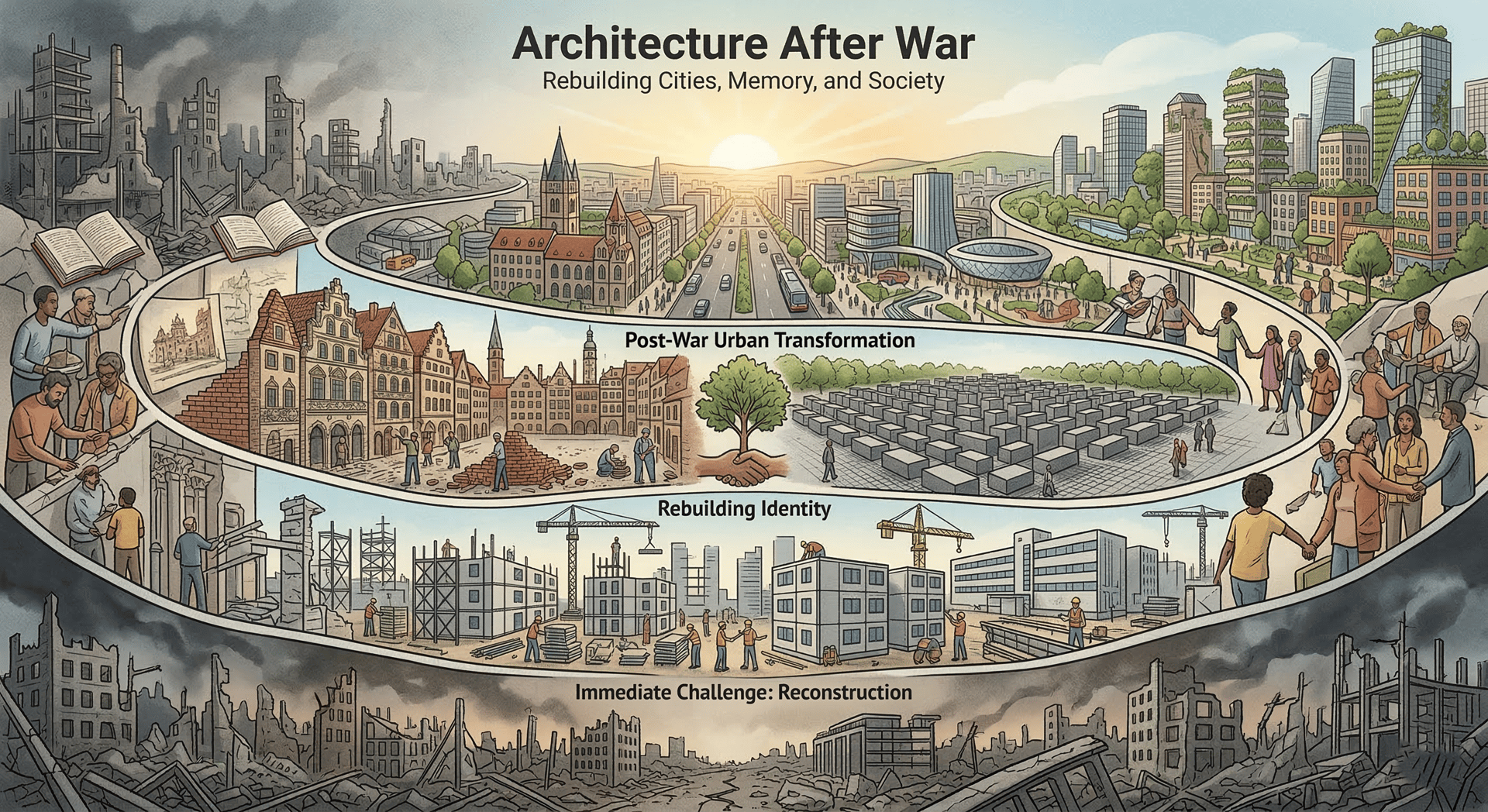
The most immediate task after war is the physical rebuilding of cities. Housing shortages, destroyed infrastructure, and damaged urban systems create urgent demands for construction at an unprecedented scale.
After World War II, many European cities—including Warsaw, Berlin, and Dresden—were almost completely destroyed. Millions of people were left homeless, and entire urban districts were reduced to rubble.
In response, governments and planners adopted large-scale reconstruction programs. Architecture during this period often prioritized speed, efficiency, and standardization. Mass housing projects, prefabricated construction, and modern planning principles became essential tools for rebuilding cities quickly.
The urgency of reconstruction also accelerated the spread of modernist architecture. The ideas of architects such as Le Corbusier—with their emphasis on rational planning, standardized housing, and functional urban organization—became influential in many reconstruction strategies.
However, rebuilding quickly was not always the same as rebuilding wisely. In many cases, large-scale reconstruction erased historic urban fabrics and replaced them with modernist planning schemes that later faced criticism for their lack of social and cultural sensitivity.
2. Rebuilding Identity
Beyond physical destruction, war often damages a city’s cultural identity. Historic buildings, monuments, and public spaces that once defined collective memory may be lost.
One of the most debated questions in post-war architecture is whether destroyed historic buildings should be reconstructed exactly as they were or replaced with new architecture reflecting contemporary values.
The reconstruction of the historic center of Warsaw after World War II is a remarkable example. The Old Town was meticulously rebuilt based on historical paintings, drawings, and archival documentation. This reconstruction was not merely architectural; it was an act of cultural resilience, restoring a symbol of national identity.
In contrast, other cities chose different strategies. In Berlin, post-war reconstruction combined modern architecture with selective preservation, creating a layered urban environment where history and modernity coexist.
These examples demonstrate that post-war architecture often involves negotiating between memory and progress.
3. Architecture and Collective Memory
War leaves deep psychological and emotional scars. Architecture can play an important role in acknowledging and preserving these memories through memorials, museums, and commemorative spaces.
Architectural memorials attempt to transform sites of trauma into places of reflection and learning. One of the most powerful examples is the Memorial to the Murdered Jews of Europe in Berlin, designed by Peter Eisenman.
The memorial does not rely on traditional symbolic monuments. Instead, it creates an immersive spatial experience composed of hundreds of concrete stelae arranged in a grid. Visitors walking through the site experience a shifting landscape of height, scale, and perspective, producing a powerful emotional and spatial response.
This approach reflects a broader shift in memorial architecture: rather than representing history through figurative symbolism, contemporary memorials often create experiential environments that allow visitors to confront memory in personal ways.
4. Post-War Urban Transformation
In many cases, post-war reconstruction became an opportunity for radical urban transformation.
Cities that had developed gradually over centuries suddenly faced the possibility of being redesigned almost from scratch. Urban planners often used this moment to introduce new transportation systems, zoning strategies, and modern infrastructure.
For example, post-war planning in Rotterdam—which had been heavily bombed during the war—embraced modern architecture and wide urban boulevards, transforming the city into one of the most modern urban environments in Europe.
Similarly, reconstruction efforts in Tokyo after the war led to major changes in urban density, infrastructure, and economic development.
These transformations demonstrate how post-war architecture can serve as a catalyst for urban innovation.
5. Social Housing and the Welfare State
Post-war reconstruction also coincided with the rise of the welfare state in many countries. Governments took responsibility for providing housing, education, and social services for rapidly growing urban populations.
Architecture played a central role in these policies. Large-scale housing projects were developed to address housing shortages and improve living conditions for working-class populations.
Architects experimented with new housing typologies, including high-rise residential blocks, modular construction systems, and prefabricated building components.
While some of these projects succeeded in providing much-needed housing, others faced long-term challenges related to social isolation, poor maintenance, and urban segregation.
These experiences highlight the complexity of designing architecture that addresses not only physical needs but also social and cultural dynamics.
6. Contemporary Post-War Reconstruction
In recent decades, new conflicts have produced additional challenges for architects and urban planners. Cities such as Aleppo, Mosul, and Gaza City have experienced severe destruction due to prolonged conflict.
Rebuilding these cities requires more than physical reconstruction. It involves addressing complex political, economic, and humanitarian conditions.
Contemporary reconstruction efforts increasingly emphasize:
community participation
cultural heritage preservation
sustainable infrastructure
resilience against future crises
International organizations such as UNESCO have also played important roles in protecting cultural heritage and supporting reconstruction initiatives.
These efforts recognize that rebuilding cities after war is not only an architectural challenge but also a social and political process.
7. Toward a Resilient Architecture
Post-war architecture has gradually evolved from simple reconstruction toward a broader concept of resilience.
Resilient architecture aims to design cities that can withstand and adapt to future disruptions—whether caused by conflict, climate change, or economic instability.
This approach emphasizes flexibility, sustainability, and community engagement. Instead of rebuilding cities exactly as they were, architects increasingly seek to create adaptive urban systems capable of evolving over time.
In this sense, post-war architecture becomes an opportunity not just to rebuild, but to reimagine how cities function and how societies live together.
Conclusion
War leaves cities in ruins, but it also forces societies to reconsider how their environments are built and organized. Post-war architecture therefore represents a unique moment in which destruction and possibility coexist.
From the reconstruction of historic districts to the creation of memorial landscapes and new urban infrastructures, architecture plays a central role in shaping how societies recover from conflict.
Ultimately, rebuilding after war is not simply about replacing what was lost. It is about restoring dignity, memory, and hope while designing cities capable of supporting a more stable and resilient future.
Architecture after war is therefore not only a technical task—it is a cultural, ethical, and human responsibility.
Begin a Design Inquiry.
Transforming ideas into breathtaking architectural realities.
contact:
Start an Inquiry:
+1 778 807 3747
© 2024. Sama Karim Design Studios. All Rights Reserved.